India’s Fertiliser Dependence and the West Asia War: A Silent Risk to Food Security

Introduction

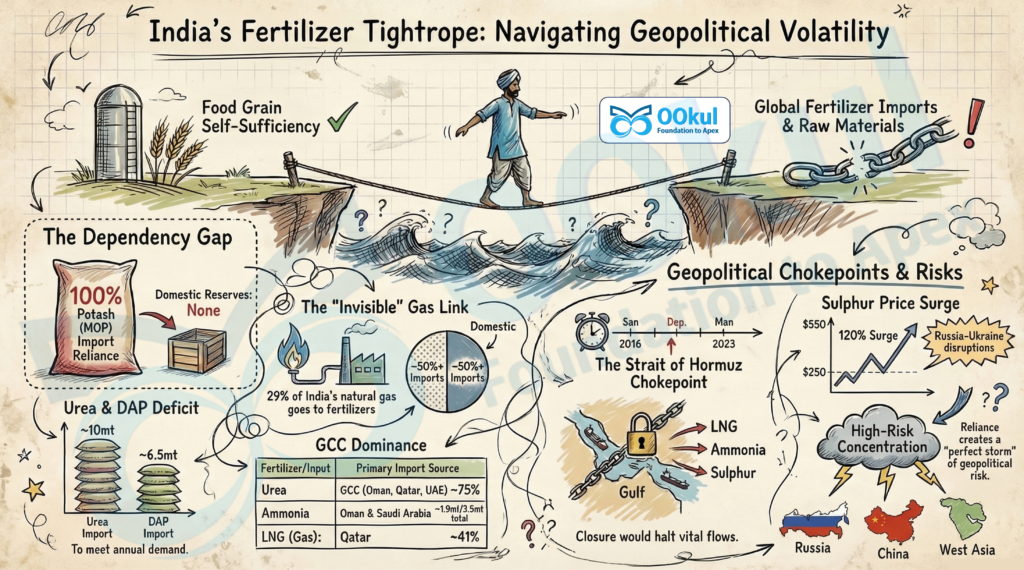
Fertilisers are essential for modern agriculture. They provide key nutrients like nitrogen (N), phosphorus (P), potassium (K) and sulphur (S), which enable crops to yield grains, fruits and vegetables. While India is broadly self-sufficient in most crops, it remains heavily dependent on imports for fertilisers and their raw materials. Ongoing geopolitical tensions, especially the US–Israel versus Iran conflict and the Russia–Ukraine war, expose a critical vulnerability in India’s food security chain.

India’s Fertiliser Demand and Import Dependence

Key fertilisers and projected requirements (2025–26)

  • Urea
    • Domestic production: ~30 million tonnes (mt)
    • Imports: ~10 mt
  • Di-ammonium phosphate (DAP)
    • Domestic production: ~3.5 mt
    • Imports: ~6.5 mt
  • Muriate of potash (MOP)
    • Domestic production: Nil
    • Imports: Entire projected consumption of ~3 mt
  • Complex fertilisers (NPKS combinations)
    • Domestic production: ~12.5 mt
    • Imports: ~4 mt

Dependence on West Asia and Other Hotspots

Gulf Cooperation Council (GCC) and West Asia

India’s fertiliser supply chain is closely tied to the Gulf region.

  • Urea imports (2024–25)
    • About 75% of urea imports came from GCC countries: Oman, Qatar, Saudi Arabia, UAE and Bahrain.
  • DAP imports
    • Saudi Arabia is the largest supplier of DAP to India.
  • MOP imports
    • GCC states themselves are minor MOP suppliers, but India significantly relies on other West Asian and nearby countries like Jordan, Israel and Turkmenistan.

Role of Russia and China

  • Russia
    • Top supplier of MOP to India.
    • Third-largest supplier of urea and DAP.
    • Major pre-war exporter of ammonia and sulphur.
  • China
    • Was India’s largest source of both urea and DAP as recently as 2023–24.

The combination of dependence on West Asia, Russia and China creates significant geopolitical risk for India’s fertiliser security.

Gas, Ammonia & Raw Materials: The Invisible Links

Natural gas and urea

  • Urea plants in India use natural gas as feedstock.
  • The fertiliser sector accounts for about 29% of India’s total natural gas consumption.
  • Over half of India’s gas requirement is met through imports.
  • LNG imports in 2024–25: ~27 mt
    • Qatar: 11.2 mt
    • UAE: 3.5 mt
    • Oman: 1.8 mt
  • April–December 2025 LNG imports: 19.9 mt
    • Qatar: 9 mt
    • UAE: 2.1 mt
    • Oman: 1.2 mt

DAP, MOP and complex fertilisers

India has very limited domestic reserves of key mineral inputs:

  • Rock phosphate (P) – almost entirely imported.
  • Potash (K) – no meaningful mineable reserves.
  • Elemental sulphur (S) – largely imported.

Ammonia imports (2024–25)

  • Total ammonia imports: ~2.5 mt (2 mt in April–December 2025).
  • Key suppliers:
    • Oman: ~1 mt (0.8 mt during April–December 2025)
    • Saudi Arabia: 0.9 mt (0.7 mt)
    • Qatar: 0.2 mt (0.06 mt)

Phosphoric acid and rock phosphate

  • DAP, India’s second most used fertiliser after urea, needs ammonia and phosphoric acid as intermediates.
  • Phosphoric acid is primarily sourced from:
    • Jordan, Senegal, Morocco, China and Tunisia.
  • Some Indian DAP producers have their own phosphoric acid plants, but the raw materials are still imported:
  • Rock phosphate suppliers
    • Jordan, Egypt, Morocco, Togo, UAE, Senegal, Algeria, Lebanon.
  • Sulphur suppliers
    • Oman, UAE, Qatar, Kuwait, Saudi Arabia.

War Disruptions and Price Shock

Impact of Russia–Ukraine war

  • Russia was a major exporter of ammonia and sulphur.
  • A 2,471-km pipeline from Togliatti (Russia) to Odesa (Ukraine), carrying about 2.5 mt of ammonia annually, was damaged in the war, causing exports to collapse.
  • Ukrainian drone attacks on Russian oil refineries have led to output losses and an export ban by Russia on certain products, including sulphur.
  • Result: Landed price of imported sulphur in India rose from around $250 per tonne to about $550 per tonne within a year.

US–Israel vs Iran conflict and the Strait of Hormuz

  • A prolonged conflict in West Asia could endanger the Strait of Hormuz, a crucial maritime chokepoint.
  • This strait is vital for shipments of:
    • LNG from QatarEnergy and Abu Dhabi National Oil Company.
    • Sulphur exports from Qatar, UAE, Saudi Aramco and others.
    • Ammonia from QatarEnergy and Saudi firms like Maaden and SABIC.
  • According to a leading fertiliser company CEO, closure of the Strait would especially hit:
  • Most affected
    • LNG, ammonia and sulphur flows.
  • Relatively less affected
    • Finished fertilisers, which can still be rerouted via the Black Sea, Turkish Straits, Mediterranean, Suez Canal, Red Sea and Indian Ocean, or around the Cape of Good Hope.

Current Stock Position: Some Breathing Space

Fertiliser stocks at end-February (comparison)

According to industry veteran G. Ravi Prasad, India’s stock position has improved compared to the previous year:

  • Urea
    • End-February stocks: 5.5 mt vs 4.9 mt a year earlier.
  • DAP
    • End-February stocks: 2.5 mt vs 1.3 mt.
  • Complex fertilisers
    • End-February stocks: 5.4 mt vs 3.2 mt.

Precarious start to the rabi season

  • On 1 October 2025 (start of rabi):
    • Urea stocks were just 3.7 mt vs 6.3 mt on 1 October 2024.
    • DAP stocks were higher: 2 mt vs 1.2 mt.
    • Complex fertiliser stocks were unchanged at 3.6 mt.

The subsequent build-up in stocks came largely through aggressive imports from both traditional and newer suppliers:

  • Newer/less prolific urea suppliers
    • Indonesia, Malaysia, Egypt, Finland, Vietnam, Algeria.
  • Newer DAP supplier
    • Australia, in addition to regular sources.

Timing advantage

  • Rabi crops (wheat, mustard, etc.) are currently being harvested.
  • The main kharif (monsoon) sowing season starts only in mid-June, about three months away.
  • This allows time to plan and preposition stocks for kharif, assuming no prolonged disruption.

Operational Stress and Uncertainty

Gas shortages and plant operations

  • Most urea plants are running at only about 60% of capacity due to insufficient gas supply.
  • Several units have opted for routine maintenance shutdowns before the peak marketing season, including:
    • Chambal Fertilisers & Chemicals’ Gadepan-II plant in Kota (Rajasthan).
    • Indorama India’s plant at Jagdishpur (Uttar Pradesh).
    • Hindustan Urvarak & Rasayan’s plant at Gorakhpur (Uttar Pradesh).

If West Asia disruptions worsen

If LNG supplies from QatarEnergy and Abu Dhabi National Oil Company are hit, and sulphur exports from the Gulf fall, India will need to diversify further.

  • Alternative LNG sources being considered:
    • US, Australia, Angola, Cameroon.
  • Alternative ammonia sources:
    • Indonesia, Malaysia, China.

Natural gas allocation priorities

Out of India’s total natural gas consumption of 58,802 mmscm (million metric standard cubic metres) during April–January 2025–26, the top three consuming segments were:

  • Fertilisers: 16,812 mmscm
  • City gas distribution (CGD): 13,699 mmscm
  • Power: 6,898 mmscm

If West Asia disruptions become severe, the government is likely to protect gas allocations for:

  • Fertilisers – to safeguard food security.
  • City gas distribution – to ensure uninterrupted clean cooking fuel and transport fuel for households and urban consumers.

Key Takeaways

  • India is substantially import-dependent for urea, DAP, MOP, complex fertilisers and their raw materials, especially gas, ammonia, rock phosphate and sulphur.
  • GCC countries (Oman, Qatar, Saudi Arabia, UAE, Bahrain) supplied about 75% of India’s urea imports in 2024–25, and are also major suppliers of LNG, sulphur and ammonia.
  • Russia and China remain crucial suppliers of fertilisers and intermediates, and ongoing conflicts have already caused supply disruptions and price spikes (e.g., sulphur prices more than doubling).
  • India’s current fertiliser stocks are comfortable, providing some cushion for the upcoming kharif season, but this relies on continued import flows.
  • A prolonged or escalated conflict in West Asia, especially any closure of the Strait of Hormuz, could seriously challenge India’s fertiliser availability and, by extension, its food security.

Conclusion

India’s self-sufficiency in food production rests on a fertiliser ecosystem that is heavily exposed to global geopolitics. Wars in West Asia and Eastern Europe have highlighted how vulnerable this system is to disruptions in LNG, ammonia, rock phosphate and sulphur supplies. While current stocks and the timing of the cropping calendar offer short-term comfort, any long-drawn conflict could pose a major challenge. Strategic diversification of supply sources, investment in domestic capacity and prudent stock management will be crucial to shield Indian agriculture and food security from external shocks.

Source: Indian Express

Share:

More Posts

Send Us A Message

Login to Get Excited Offer !