SMILE: Imaging Earth’s Magnetic Shield Against Solar Wind
Overview The Mission: The Solar wind Magnetosphere Ionosphere Link Explorer (SMILE) is a space mission designed to study how Earth’s magnetic field protects the planet


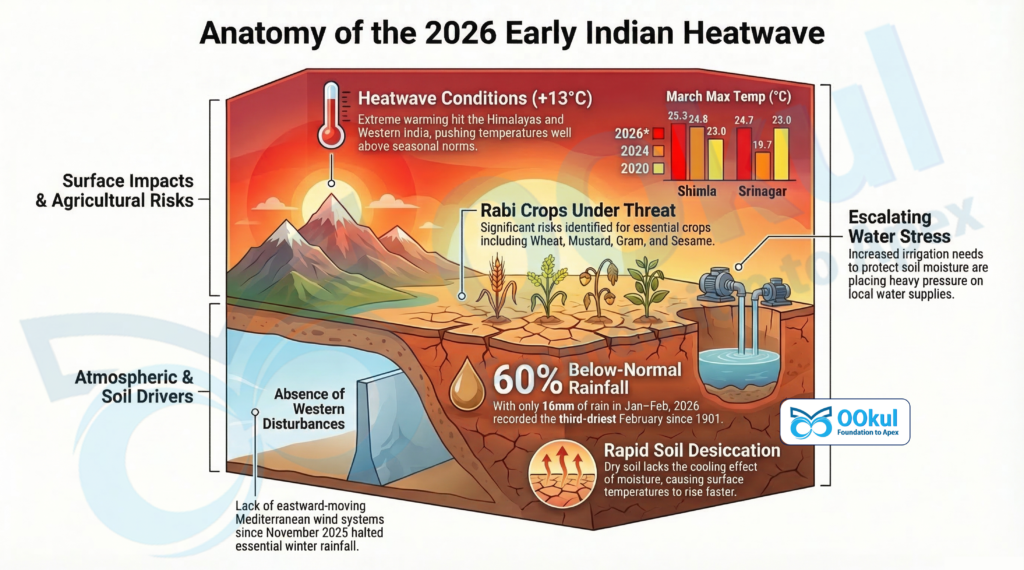
In several regions of India, particularly in the north and west, the cool winter days of February were suddenly replaced by unusually warm days in March. Temperatures were 8–13°C above normal, which can be classified as heat-wave conditions.
Although a similar situation occurred three years ago, such an early arrival of heat is rare.
In its March forecast, the India Meteorological Department (IMD) stated that day temperatures across the western Himalayan region and parts of peninsular and central India will remain above normal.
The IMD also warned of above-normal heatwave days in Gujarat and Andhra Pradesh.
Examples of unusual warming:
Himachal Pradesh recorded temperatures above 25°C.
In Shimla, temperatures crossing 25°C in March are extremely rare.
Similar conditions were seen in Jammu and Kashmir and Ladakh.
According to Mrutyunjay Mohapatra, temperatures are likely to remain high for a few days until the arrival of the next Western Disturbance.
Western Disturbances are eastward-moving rain-bearing wind systems that originate beyond Iran and gather moisture from the Mediterranean Sea and nearby water bodies. They are the primary source of winter rainfall in north India.
The unusual weather is partly due to a dry winter season.
Key observations:
February 2026 was the third driest February since 1901.
All-India rainfall in January–February was only 16 mm, which is 60% below normal.
Both rainfall and snowfall were significantly reduced.
Lack of adequate Western Disturbances since November 2025.
Weak wind convergence between westerly and easterly winds, which usually brings moisture from the seas to central and northern India.
Dry winters generally lead to early summers because:
Lack of rain dries the soil quickly.
Dry soil heats up faster than moist soil.
This increases surface temperatures earlier in the year.
The sudden temperature rise is likely to affect rabi crops.
Mustard
Wheat
Gram
Groundnut
Sesame
Sorghum
Safflower
Other affected crops:
Vegetables like potato
Fruits such as apples
Farmers have been advised to increase irrigation frequency to maintain soil moisture.
However, this may increase stress on local water resources.
| Year | Shimla | Pahalgam | Gulmarg | Srinagar |
|---|---|---|---|---|
| 2026* | 25.3 | 22.7 | 17.2 | 24.7 |
| 2025 | 24.4 | 20.4 | 14.3 | 23.2 |
| 2024 | 24.8 | 19.9 | 13.2 | 23 |
| 2023 | 20.4 | 20.4 | 13.8 | 23.4 |
| 2022 | 26.3 | 24.3 | 17 | 27.6 |
| 2021 | 24.4 | 19.2 | 12 | 22.2 |
| 2020 | 19.7 | 17.4 | 11 | 20.8 |
Temperatures recorded till March 8, 2026. Source: IMD.
Source: Indian Express