The Debate on Banning Social Media for Minors: Efficacy and Alternatives
Introduction to the Proposed Bans Recently, Karnataka and Andhra Pradesh announced plans to restrict social media access for children under 16 and 13, respectively. This


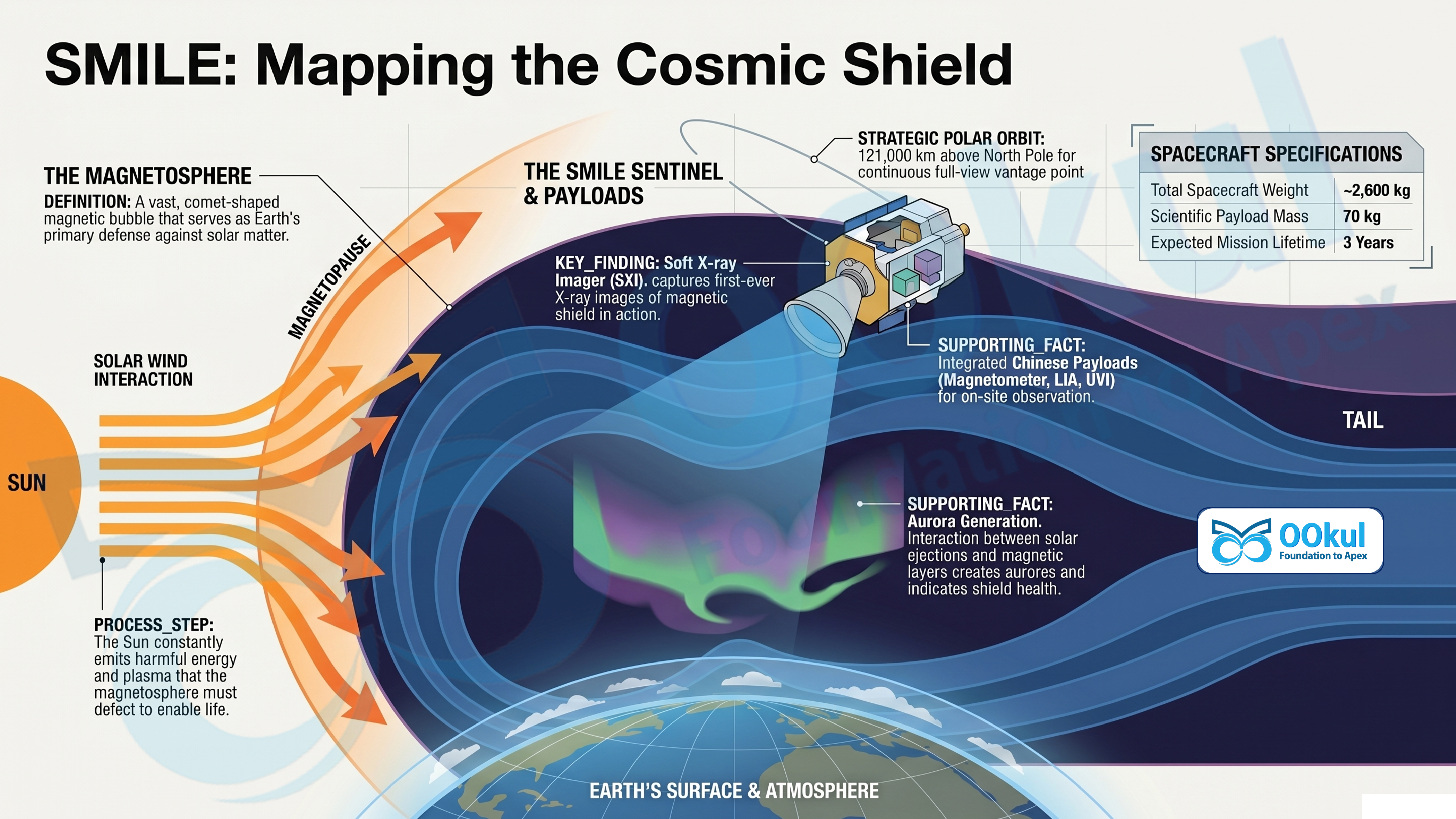
Overview
The Mission: The Solar wind Magnetosphere Ionosphere Link Explorer (SMILE) is a space mission designed to study how Earth’s magnetic field protects the planet from the Sun.
A Historic Collaboration: This is the first time Chinese and European space agencies are sending a joint mission into space.
International Contribution: European nations collaborating with China on this mission include Austria, Belgium, Denmark, France, Germany, Italy, Luxembourg, the Netherlands, Norway, Spain, Switzerland, and the UK.
Launch Details: The spacecraft is scheduled to launch on a European Vega-C rocket at 05:52 CEST (09:22 IST) on a Tuesday.
Core Objectives and Capabilities
First-of-its-Kind Imaging: SMILE aims to capture the first-ever X-ray images of Earth’s protective magnetic shield in action as it deflects harmful solar particles and plasma.
Real-Time & Full View: Unlike past missions, SMILE will provide real-time, full-view imaging of the interactions occurring within the magnetosphere.
Studying Auroras: It will capture the full spectrum of solar ejections interacting with Earth’s outer magnetic layers—the process that generates auroras (“dancing lights”) and enables life to exist on Earth.
The Earth’s Shield and Early Warnings
The Magnetosphere: The Sun constantly spews harmful matter, energy, and magnetic fields (space weather). Earth is protected by its magnetosphere—a vast, comet-shaped bubble that is one of the strongest in the solar system.
Infrastructure Protection: By studying these interactions, SMILE will help establish an early warning system to protect ground-based infrastructure (like electricity grids) and space assets from severe solar flares.
Building on Past Missions: While past missions like the European Space Agency’s (ESA) Swarm and Cluster helped understand this region, SMILE will significantly enhance forecasting accuracy and effectiveness.
Technical Specifications and Orbit
Weight and Lifespan: The SMILE spacecraft weighs approximately 2,600 kg and has an expected mission lifetime of about three years.
Orbit Position: It will be placed around 1.21 lakh km above Earth’s north pole, a vantage point that allows it to fully observe the edge of the magnetosphere.
Scientific Payloads (Instruments)
The mission carries four scientific instruments weighing a combined 70 kg. They will utilize both remote sensing and in situ (on-site) observations across X-ray and ultraviolet wavelengths:
Developed by ESA: Soft X-ray Imager (SXI).
Developed by China: Magnetometer, Light Ion Analyser (LIA), and Ultraviolet aurora Imager (UVI).
Significance for Space Weather Forecasting
The data collected will help solar physicists better forecast solar storms and perturbations.
Enhanced forecasting is critical to ensuring the safety of astronauts, uninterrupted operations of space stations, and safeguarding space-based assets like satellites, GPS, and airline operations.