India–Canada Uranium Deal: Why It Matters for India’s Nuclear Energy Future

Overview

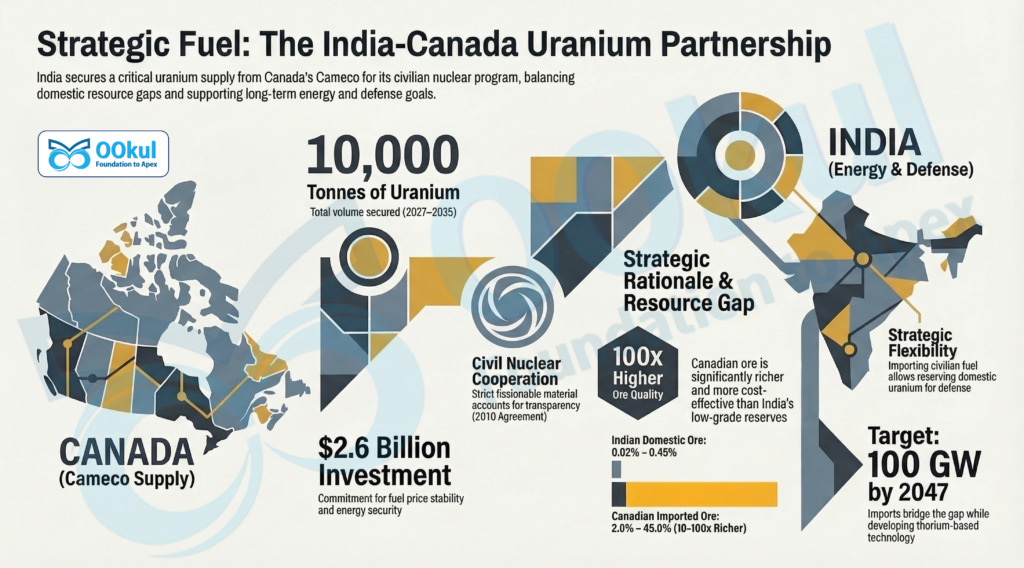
India has signed a Canadian $2.6-billion deal with Cameco, one of the world’s largest uranium producers. The agreement secures around 10,000 tonnes of uranium supplies to India between 2027 and 2035, strengthening the country’s energy security and its civilian nuclear power programme.

Key Takeaways

  • India will import about 10,000 tonnes of uranium from Canada (2027–2035).
  • Imports already meet nearly three-fourths of India’s civilian uranium requirements.
  • The deal operates under the 2010 India–Canada Civil Nuclear Cooperation Agreement.
  • Uranium is critical for India’s nuclear power, medical isotope production, and strategic programmes.
  • Delays in India’s three-stage nuclear programme make assured uranium supply strategically important.

India’s Uranium Resources and Imports

Domestic Uranium Reserves

India has both domestic uranium reserves and imported stocks.

  • Ore reserves: Around 4.2–4.3 lakh tonnes of uranium ore.
  • Estimated extractable uranium metal: 76,000–92,000 tonnes.
  • Major mines:
    • Jaduguda (Jharkhand)
    • Turamdih (Jharkhand)
    • Tummalapalle (Andhra Pradesh)

Ore Quality: India vs Canada

  • India’s ore: Low-grade, with uranium concentration of about 0.02–0.45%.
  • Canada’s ore: High-grade, about 10–100 times richer than Indian ore.

Because Indian ore is low-grade, extracting uranium domestically is relatively costlier compared to importing higher-grade ore.

Current Import Dependence

India increasingly relies on imported uranium, which currently meets nearly three-fourths of its civilian needs.

Key uranium suppliers:

  • Canada (Cameco): New deal for 10,000 tonnes (2027–2035).
  • Kazakhstan (Kazatomprom): Supply agreement finalised in February.
  • Uzbekistan and Russia: Ongoing contracts, both mainly with low-grade ore.

The government is also building a strategic uranium reserve sufficient for five years of fuel, to cushion against supply chain shocks.

Civil vs Military Use

  • Imported uranium: Cheaper, but bound by international safeguards and cannot be used in nuclear weapons.
  • Domestic uranium: Can be used for both civilian and strategic (weapons and naval) purposes.

As imports support civilian reactors, more domestic uranium can be diverted for strategic needs, including nuclear warheads and nuclear-powered submarines.

The 2010 India–Canada Civil Nuclear Cooperation Agreement

Background

  • Signed in 2010 after the Nuclear Suppliers Group (NSG) granted India a “clean waiver” in 2008.
  • The NSG waiver allowed India to engage in civil nuclear trade despite not being a signatory to the Nuclear Non-Proliferation Treaty (NPT).
  • The waiver itself followed the India–U.S. “123” civil nuclear agreement.

Key Features and Concerns

  • The Cameco supply deal operates under this Nuclear Cooperation Agreement (NCA).
  • India must provide “fissionable material accounts” to Canada, making the agreement more intrusive than some other supply contracts (e.g., with Kazakhstan).
  • Sovereignty concerns: Critics see these accounting requirements as a mild infringement on India’s sovereignty.
  • Weapons programme concerns: Others argue that by freeing up domestic uranium for strategic use, the NCA indirectly supports India’s nuclear weapons capability.

How India Uses Its Uranium

Civilian Nuclear Power

  • India operates 24 nuclear reactors with an installed capacity of about 9 GW.
  • 700 MW Pressurised Heavy Water Reactors (PHWRs):
    • Currently provide about 6–7 GW of capacity.
    • Account for roughly 3% of India’s total electricity generation.
    • Use natural uranium as fuel.
  • The government aims to increase nuclear power capacity to 100 GW by 2047.

Past expansion plans have faced delays due to land acquisition challenges and local protests around proposed nuclear sites.

Research and Medical Applications

Uranium fuels research reactors, which support key scientific and medical activities.

  • Research reactors (e.g., Dhruva, Trombay):
    • Produce medical isotopes such as technetium-99m and iodine-131.
    • Support advanced materials science research and other high-end experiments.

New Small Modular Reactors (SMRs)

  • The 2025–26 Union Budget allocates ₹20,000 crore to develop a new generation of small modular reactors (SMRs).
  • SMRs typically use 3–5% enriched uranium as fuel.

Strategic and Defence Use

  • Nuclear warheads: India’s arsenal is estimated at around 170 warheads, relying on domestic uranium and plutonium.
  • Nuclear-powered submarines: The INS Arihant-class submarines use nuclear fuel for propulsion, contributing to India’s sea-based deterrent.

India’s Three-Stage Nuclear Power Programme

Stage 1: PHWRs (Current Stage)

  • Uses natural uranium-235 as fuel in pressurised heavy water reactors.
  • Produces electricity and generates plutonium-239 as a byproduct.
  • This is the stage where India currently operates most of its reactors.

Stage 2: Fast Breeder Reactors (Transition Stage)

  • Fast breeder reactors use mixed oxide (MOX) fuel made of uranium-238 and plutonium-239.
  • They produce:
    • Electricity
    • Uranium-233
    • More plutonium-239 than they consume (hence “breeder”)
  • The Prototype Fast Breeder Reactor (PFBR) at Kalpakkam is in an advanced stage of commissioning.

Stage 3: Thorium-Based Reactors (Future Stage)

  • Advanced heavy water reactors will use plutonium-239 and thorium-232 as fuel.
  • They are designed to produce:
    • Electricity
    • Uranium-233 from thorium-232
  • This strategy leverages India’s large thorium reserves — about 20–25% of the world’s thorium deposits.

Delays and Challenges in the Nuclear Programme

Historical Delays

  • A fast breeder test reactor was built at Kalpakkam in 1977.
  • However, government approval for the large-scale PFBR came only in the early 2000s.
  • Delays were partly due to international sanctions after India’s nuclear tests.

Cost Overruns

  • PFBR’s estimated cost nearly doubled:
  • From about ₹3,492 crore at design stage to more than ₹6,800 crore by 2019.

Timeline for Thorium Deployment

  • In March 2013, the Department of Atomic Energy stated in Parliament that large-scale thorium deployment would begin 3–4 decades after commercial fast breeder reactors are operational with short doubling time.
  • Given the PFBR’s delays, widespread thorium use may only be realistic by the 2060s or later.

Doubling Time and Capacity Expansion

  • Former DAE Chairman Anil Kakodkar estimates the doubling time for a fast breeder reactor — the time to produce enough fuel to start a second reactor — at 15–20 years.
  • To reach the target of 100 GW of nuclear power, India must pass through multiple such doubling cycles.
  • This lengthy multiplication process helps explain why India is aggressively securing uranium supplies through multiple international deals.

Why the Canada–Cameco Deal Matters for India

  • Energy security: Long-term uranium supply underpins India’s plan to expand nuclear power to 100 GW by 2047.
  • Stable fuel for PHWRs and SMRs: Assured supplies support existing PHWRs and potential new small modular reactors.
  • Strategic flexibility: Imported uranium for safeguarded civilian use frees more domestic uranium for strategic and advanced reactor needs.
  • Bridging programme delays: Given slow progress on breeder and thorium stages, imported uranium is critical to keep nuclear capacity growth on track.
  • International credibility: Operating under a formal NCA with material accounting strengthens India’s profile as a responsible nuclear power.

Summary

  • India’s low-grade uranium ore and limited extractable reserves make imports both economical and necessary.
  • The Cameco deal, under the 2010 India–Canada NCA, secures 10,000 tonnes of uranium from 2027–2035.
  • Uranium fuels India’s power reactors, research facilities, medical isotope production, and strategic defence assets.
  • Delays in the three-stage nuclear programme and long breeder reactor doubling times mean India must ensure steady uranium supplies for decades.
  • By marrying international uranium deals with domestic reactor development, India aims to gradually move towards its long-term vision of a thorium-based, high-capacity nuclear power system.

Source: The Hindu

Share:

More Posts

Send Us A Message

Login to Get Excited Offer !