Overview of the Report
The Delhi-based Centre for Science and Environment (CSE) released its report State of India’s Environment 2026 on February 25. Published annually since 1982, this report offers a comprehensive view of India’s environmental status and connects local trends with the global climate crisis.
The 2026 edition highlights multiple, overlapping crises:
- Sharp rise in frequency and severity of extreme weather events
- Growing flood risk in a warming climate
- Changing tiger behaviour and rising human–tiger conflict
- Serious gaps and inequalities in air pollution monitoring
Extreme Weather Events: Rising Frequency and Impact
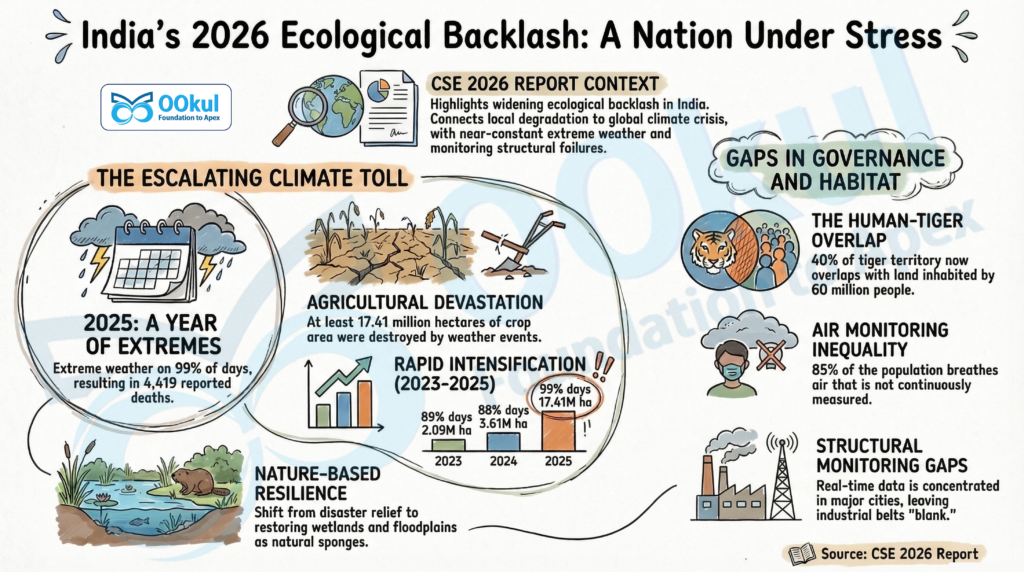
CSE’s analysis shows that 2025 was India’s worst year in the past four years for extreme weather events, both in terms of how often they occurred and how severe they were.
Key data on 2025 extreme weather
- Types of events: Heatwaves, cold waves, heavy rainfall and floods
- Days affected: Extreme weather was recorded on 99% of days between January 1 and November 30, 2025
- Reported deaths: 4,419 people
- Agricultural impact: At least 17.41 million hectares of crop area affected
Trends over the last three years
- 2025: 99% of days with extreme events; 4,419 deaths; 17.41 million ha crop area affected
- 2024: 88% of days; 3,393 deaths; 3.61 million ha crop area affected
- 2023: 89% of days; 3,208 deaths; 2.09 million ha crop damage
The report notes that Himachal Pradesh was the worst-affected State in terms of extreme weather, followed by Kerala and Madhya Pradesh.
CSE concludes that the pattern points to a “widening ecological backlash” and stresses that without strong climate mitigation and risk-reduction measures, such disasters could become the norm.
Floods in a Warming Climate
The report links the warming climate to a substantial increase in the likelihood of widespread floods across India. Climate change, it argues, is already reshaping rivers, cities and daily life, and can no longer be treated as a distant risk.
Key messages on floods
- Climate change is already influencing hydrology, rainfall and flood patterns.
- India must shift from a post-disaster relief approach to a pre-disaster resilience approach.
- Planning must integrate climate science at all levels — from culvert design to land use along rivers.
Recommended nature-based solutions
- Restoring wetlands to act as natural sponges for floodwaters
- Reconnecting rivers to floodplains to allow safe overflow and recharge
- Recharging groundwater to store excess water and reduce surface runoff
- Rainwater harvesting in both rural and urban areas
- Restoring and constructing lakes as buffers and storage systems
Changing Tiger Behaviour and Human–Tiger Conflict
The CSE report records a worrying trend of rising human–tiger conflict around tiger reserves and forest areas.
Recent incidents and numbers
- From January to June 2025, at least 43 people were killed near tiger reserves.
- In four of these cases, tigers consumed parts of the victims.
- In the same period in 2024, 44 deaths from tiger attacks were reported.
Why are tiger attacks rising?
The report explains that tigers rarely become habitual human-eaters. However, attacks and occasional consumption of humans can increase when:
- Tigers are old or injured and unable to hunt usual prey
- Their natural prey base declines
- Human activity encroaches on tiger habitats
Population pressure and habitat overlap
- Both tiger populations and the number of people living near forests are rising.
- In 20 States with tiger populations, about 40% of tiger territory overlaps with land inhabited by roughly 60 million people.
- Tiger populations inside many reserves are at saturation point, pushing big cats outside protected areas.
Experts cited in the report attribute behavioural changes to overcrowding of tigers in reserves, habitat loss and growing human presence around tiger territories.
Air Pollution: Gaps in Monitoring and Structural Inequality
CSE finds that air quality monitoring in India is heavily skewed towards a few large cities, leaving the majority of the population outside any continuous monitoring network.
Coverage of air quality monitors
- Only about 15% of India’s population (around 200 million people) live within 10 km of a continuous air quality monitor.
- The remaining 85% (over 1.2 billion people) breathe air that is not continuously measured.
Spatial inequality in monitoring
- Monitoring is concentrated in state capitals and major metropolitan areas.
- Entire districts, industrial belts and peri-urban regions lack real-time monitoring.
- This creates a fragmented picture: some zones have dense data, while vast regions appear blank.
The report frames this not just as a technical gap but as a form of structural inequality in environmental governance. Many smaller towns — often with comparable or higher pollution because of local industries and transport — have no real-time data, limiting both public awareness and policy response.
Conclusion: From Ecological Backlash to Climate Action
The State of India’s Environment 2026 report paints a picture of a country under mounting ecological stress — from deadly extreme weather and intensifying floods to contested wildlife habitats and invisible air pollution in unmonitored regions.
CSE’s central message is clear: India must move rapidly from reactive responses to proactive, science-based and inclusive environmental planning, combining climate mitigation, resilience-building and better environmental governance across the country.
Source: The Hindu