Why the US Is Shifting from Standoff Missiles to Gravity Bombs Against Iran

Context: US Move to Direct Bombardment

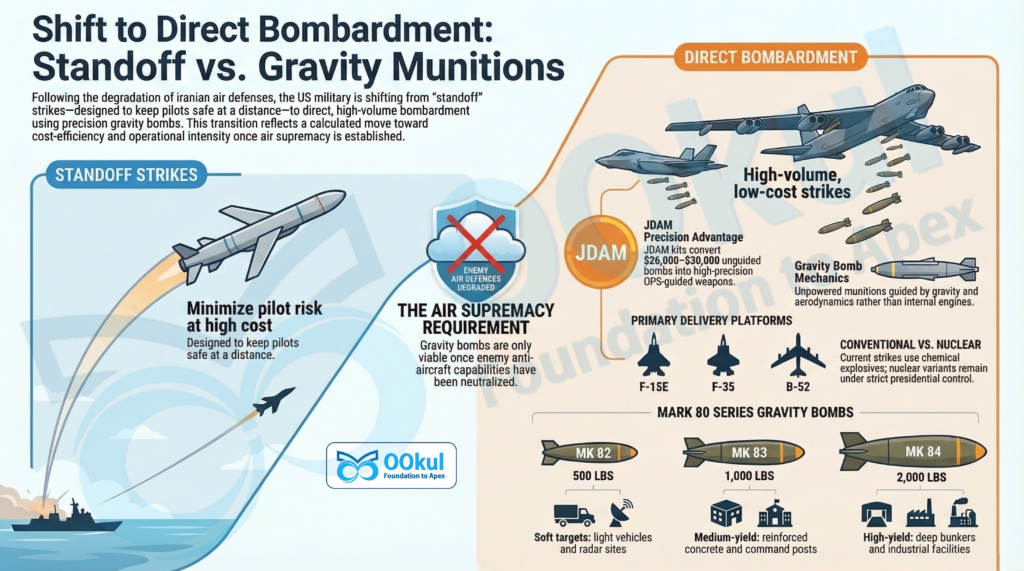
On Wednesday, US Defense Secretary Pete Hegseth announced that Iranian air defences have been severely degraded over the last four days. On this basis, the US military plans to begin deploying 500‑pound, 1,000‑pound, and 2,000‑pound precision gravity bombs. This marks a shift from cautious long‑range “standoff” strikes to more direct, high‑volume bombardment.

Munitions Used So Far: Standoff Weapons

Until now, the US campaign has relied mainly on long‑range, high‑cost standoff munitions designed to keep pilots outside the range of Iranian air defences.

Key Features of Standoff Munitions

  • Launched from outside the envelope of enemy air defence systems.
  • Target early‑warning radars and surface‑to‑air missile (SAM) batteries.
  • Deployed from US naval destroyers and stealth aircraft.
  • Minimise the risk to pilots by avoiding overflight of heavily defended airspace.

Examples Used in the Current Campaign

  • Tomahawk Cruise Missile
    • Long‑range, precision‑guided missile with its own engine.
    • Used to dismantle Iranian radar and SAM sites from a safe distance.
  • LUCAS Drones (Low‑cost Unmanned Combat Attack System)
    • Unmanned aircraft used as expendable strike platforms.
    • Support US–Israeli efforts to establish control over Iranian airspace.

What Is a Gravity Bomb?

A gravity bomb, or “free‑fall” bomb, is an unpowered munition. Unlike a cruise missile, it has no internal engine.

How Gravity Bombs Work

  • Released from an aircraft and guided only by gravity, aerodynamics, and the aircraft’s speed and altitude.
  • Modern versions are fitted with guidance kits to achieve high precision.
  • Form the backbone of US Air Force strike capability despite their older‑sounding name.

US Conventional Gravity Bombs: Mark 80 Series

The current US campaign relies on the conventional Mark 80 series, often upgraded with Joint Direct Attack Munition (JDAM) kits.

  • 500‑pound MK 82
    • Used against “soft” targets such as light vehicles, radar installations, and exposed infantry positions.
  • 1,000‑pound MK 83
    • Medium‑yield bomb for reinforced concrete structures, command posts, and smaller bridges.
  • 2,000‑pound MK 84
    • High‑yield bunker‑buster.
    • Capable of destroying deep underground complexes and large industrial facilities.
    • Can create craters up to about 50 feet wide and 36 feet deep.

JDAM Kits and Precision Guidance

  • JDAM (Joint Direct Attack Munition) kits convert unguided bombs into precision weapons.
  • Tail sections include GPS receivers and steerable fins.
  • Allow bombs to glide accurately to specific coordinates.
  • Each conventional bomb with JDAM typically costs around US$25,000–30,000.

Conventional vs Nuclear Gravity Bombs

Conventional Gravity Bombs

  • Use standard chemical explosives.
  • Deployed routinely by theatre commanders.
  • Employed in past campaigns in Iraq, Afghanistan, and Syria (against ISIS), and by Israel in Gaza and Lebanon.

Nuclear Gravity Bombs

  • Examples include the B61 and B83 series.
  • Measure yield in kilotons or megatons of TNT.
  • Require explicit authorisation from the US President.
  • Their use would signal a major global nuclear escalation.

The bombs referenced by Hegseth in the current campaign are strictly conventional, not nuclear.

Why Is the US Shifting to Gravity Bombs?

The move from standoff missiles to conventional gravity bombs reflects a calculated trade‑off between cost, risk, and operational objectives.

Cost vs Risk Trade‑off

  • Standoff Missiles
    • Very expensive (often millions of dollars each).
    • Keep pilots completely outside hostile air defence coverage.
  • Gravity Bombs
    • Much cheaper and available in larger numbers.
    • Enable high‑volume bombardment.
    • Require aircraft to fly over or very close to the target, increasing risk to pilots.

Requirement of Air Supremacy

  • Gravity bombs are only viable when a force has air supremacy—effective control of the airspace and suppression of enemy air defences.
  • Hegseth’s statement implies that the Pentagon believes Iranian anti‑aircraft capabilities have been largely neutralised.

What Is the US Air Force Deploying Now?

The US is focusing on the conventional Mark 80 series gravity bombs, fitted with JDAM kits where needed.

Typical Aircraft Platforms

  • Tactical Fighters
    • F‑15E Strike Eagle
    • F‑35 stealth jets
  • Strategic Bombers
    • B‑52 Stratofortress and similar heavy bombers

Summary

  • The US has degraded Iranian air defences and is shifting from long‑range standoff weapons to direct use of 500‑lb, 1,000‑lb, and 2,000‑lb gravity bombs.
  • Standoff munitions like Tomahawk missiles and LUCAS drones helped first suppress air defences while keeping pilots safe.
  • Gravity bombs, especially the Mark 80 series with JDAM kits, offer cheaper, precise, high‑volume strike options once air supremacy is achieved.
  • The bombs now being discussed are conventional, not nuclear; nuclear gravity bombs remain under strict presidential control.

Source: Indian Express

Share:

More Posts

Send Us A Message

Login to Get Excited Offer !