Overview
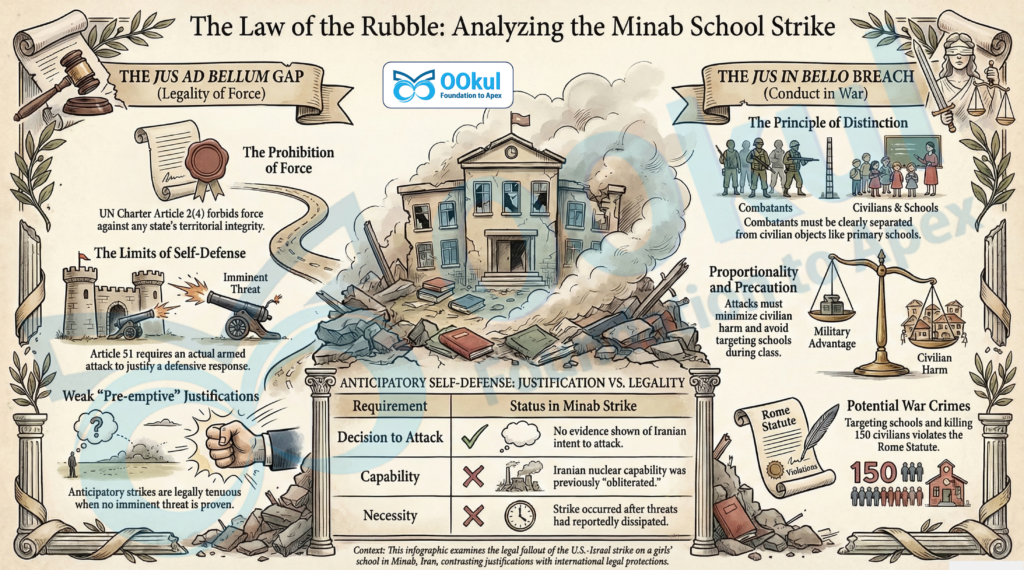
This post examines the legality of recent U.S.-Israel strikes on Iran under the UN Charter and International Humanitarian Law (IHL), with a focus on the missile strike that hit a girls’ primary school in Minab, southern Iran, reportedly killing around 150 people and injuring nearly 100, many of them children.
UN Charter and the Use of Force
- The UN Charter (1945) was created to prevent the “scourge of war” and maintain international peace and security.
- Article 2(4) prohibits the threat or use of force against the territorial integrity or political independence of any state.
- Only the UN Security Council may authorise the use of force against a member state to address threats to international peace.
- Article 51 allows the use of force in self-defence only in response to an actual armed attack.
Self-defence vs ‘Pre‑emptive’ Strikes
- The U.S. and Israel described the February 28 strikes as a ‘pre-emptive’ response to an imminent Iranian threat.
- Under the Charter framework, they cannot convincingly claim self-defence because:
- Iran had not recently attacked either the U.S. or Israel.
- Any earlier threat is considered to have dissipated.
- At most, the strikes rest on the theory of anticipatory self-defence to prevent a future attack.
Debate on Anticipatory Self-defence
- Many scholars argue that international law does not accept self-defence against an attack that has not yet occurred.
- Even under a broad reading of anticipatory self-defence, three conditions must be met:
- Iranian leadership had decided to attack the U.S. or Israel.
- Iran had the capability to carry out such an attack.
- Force was necessary now, as this was the last window to prevent that future attack.
- The argument is weaker today because:
- U.S. strikes in June 2025 had already degraded Iran’s nuclear capability.
- President Donald Trump claimed Iran’s nuclear programme had been “obliterated”.
- No credible evidence has been shown that Iran reconstituted its programme, formed intent to build a weapon, and prepared to use it.
- Regime change and protection of populations from their own government are also not recognised by the UN Charter as lawful stand‑alone justifications for the use of force.
International Humanitarian Law (IHL)
While the UN Charter governs when force may be used (jus ad bellum), IHL governs how wars are fought (jus in bello), irrespective of who started the conflict.
Origins and Scope
- Modern IHL is chiefly codified in the Geneva Conventions of 1949, supplemented by additional treaties and customary law.
- IHL aims to limit human suffering by:
- Protecting the wounded, sick, prisoners of war, and civilians.
- Restricting brutal weapons and methods of warfare.
- It is built on four core principles:
- Distinction
- Proportionality
- Military necessity
- Precaution
Principle of Distinction and the Minab School Strike
- The principle of distinction requires clear separation between:
- Combatants and military targets, and
- Civilians and civilian objects (schools, hospitals, places of worship, public transport).
- Where there is any doubt about a target’s nature, it must be presumed civilian.
- The missile strike on the girls’ primary school in Minab appears to blatantly violate this principle.
Protection of Children and Education
- The Convention on the Rights of the Child recognises children as rights‑bearing individuals.
- Article 38(4) requires states to take all feasible measures to protect and care for children affected by armed conflict.
- The Rome Statute of the International Criminal Court classifies as war crimes:
- The intentional targeting of civilians.
- Attacks on buildings dedicated to education.
- Civilian objects can lose protection if used for military purposes (e.g., as bases, artillery sites, command posts).
- So far, there is no evidence that the Minab school was being used militarily or deliberately targeted.
Proportionality, Necessity, and Collateral Damage
The key legal issue is how to assess the strike if the school was not the intended target but suffered as collateral damage from an attack on a nearby Islamic Revolutionary Guard Corps facility.
- IHL allows that civilian objects may be incidentally affected during attacks on military objectives.
- Such harm is lawful only if it meets the tests of:
- Proportionality – expected civilian harm must not be excessive relative to the concrete and direct military advantage anticipated.
- Military necessity – the attack must be necessary to achieve a legitimate military objective.
- Precaution – all feasible steps must be taken to minimise civilian harm.
- Commanders must consider:
- Verification of the target’s nature.
- Presence of civilians and civilian infrastructure nearby.
- Choice of weapons to limit collateral damage.
- Timing of the strike to reduce risks to non‑combatants (e.g., avoiding school hours).
Role and Relevance of International Law
- Frequent breaches of international law lead some to question its relevance.
- However, most day‑to‑day international activity — diplomacy, trade, aviation, maritime navigation, environmental cooperation, arms control — generally complies with legal rules.
- International law’s importance lies in its capacity to demand justification from states that use force.
- Through norms and legal argument, it enables the global community to:
- Identify unlawful actions.
- Scrutinise official narratives.
- Condemn serious violations.
- The central challenge is not the absence of law, but the gap between legal norms and state practice.
Key Takeaways
- Under the UN Charter, only the UN Security Council can authorise force against a member state, except for self-defence against an actual armed attack.
- The U.S.-Israel justification based on pre‑emptive or anticipatory self-defence appears weak under international law.
- IHL strictly protects civilians and civilian objects; the Minab school strike raises serious concerns under the principles of distinction, proportionality, necessity, and precaution.
- Targeting civilians and schools can amount to war crimes under the Rome Statute, particularly when children are affected.
- International law remains vital as a framework for accountability, ensuring that when bombs fall on classrooms and playgrounds, the legal and moral failures are visible and open to global condemnation.
Source: The Hindu