Is the Supreme Court Doing Enough to Tackle Hate Speech?

This post summarises a panel discussion between Shahrukh Alam (SA) and Haris Beeran (HB), moderated by Aaratrika Bhaumik, on whether the Supreme Court of India is doing enough to address hate speech.

Background: Recent Court Developments

  • Gauhati High Court notice to Assam CM: On February 26, the Gauhati High Court issued notice to Assam Chief Minister Himanta Biswa Sarma on petitions seeking criminal prosecution for alleged communal and divisive speeches.
  • Supreme Court’s earlier role: Petitioners had first approached the Supreme Court (SC). A three-judge Bench, headed by Chief Justice of India Surya Kant, observed that approaching elections often turn the Court into a political battleground and directed them to the Gauhati High Court.
  • Closing of hate speech matters: In January, another SC Bench indicated that hate speech matters pending since 2021 would be closed, while clarifying that parties could still seek remedies before High Courts and other forums.

What Is Hate Speech and Why Is It Hard to Criminalise?

Beyond direct incitement to violence

  • Shahrukh Alam:
    • Hate speech is not always an open call to violence.
    • It often functions as a prejudicial discourse that marginalises specific communities.
    • Because of this, defining hate speech for criminal law is inherently difficult; not every divisive or offensive remark should attract penal consequences.
    • The threshold for criminal sanction must be higher than mere offensiveness.

Role of power and perception

  • Power and hierarchy (SA):
    • The harm of hate speech cannot be separated from existing unequal social hierarchies.
    • It is usually directed at already vulnerable groups, reinforcing exclusion and creating a democratic deficit.
  • Ambiguity and dog whistles (HB):
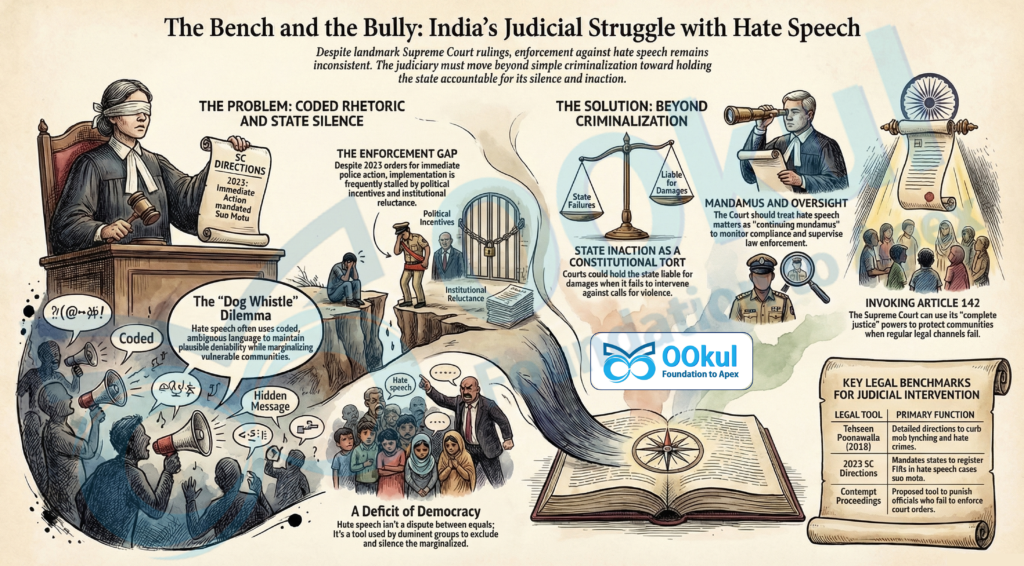
    • Hate speech frequently appears as dog whistles—coded, ambiguous statements designed to enable plausible deniability.
    • The impact is shaped by how speech is perceived, not just by its literal wording.
    • This ambiguity makes it hard to set clear, workable thresholds for criminal liability.

Should Hate Speech Be Treated as a Constitutional Tort?

Argument for constitutional tort (SA)

  • Even when there are open calls for violence, the state’s response is often missing.
  • Repeated inaction by the state and its functionaries creates grounds to hold the state accountable.
  • Constitutional tort would allow courts to:
    • Recognise that state inaction has caused harm.
    • Impose responsibility through acknowledgment of failure or compensation to affected individuals or communities.

Link to ruling dispensation and institutions (HB)

  • Hate speech is tied closely to electoral strategies of the ruling establishment.
    • Communal rhetoric is used to gain attention and electoral advantage.
    • When top leadership uses such rhetoric, lower-level functionaries emulate it.
  • Institutional actors such as the police and the Election Commission of India (EC) often fail to intervene credibly.
  • Recognising hate speech as a constitutional tort would help courts fix accountability and award compensation for failures to act.

How Effective Has the Supreme Court’s Intervention Been?

Existing directions and gaps (HB)

  • Tehseen Poonawalla vs Union of India (2018):
    • SC issued detailed directions to curb mob lynching and hate crimes.
    • Included appointment of nodal officers in each State.
  • 2023 directions: States were directed to suo motu register FIRs in hate speech cases.
  • Despite these orders, violations persist, with poor compliance.
  • HB suggests the SC should:
    • Use contempt proceedings against officials who fail to act.
    • Invoke its powers under Article 142 to do “complete justice,” especially to protect vulnerable communities.
  • As an example of reluctance, he cites the Court’s decision to send complaints against the Assam CM to the High Court instead of acting directly.

Supervision and power imbalance (SA)

  • SA notes that SC directives on hate speech are often honoured in the breach.
  • Petitioners had requested that ongoing hate speech matters be treated as a continuing mandamus so the SC could:
    • Keep the issues under ongoing supervision.
    • Monitor compliance and step in where necessary.
  • The Court instead chose to close the proceedings.
  • Law enforcement regularly fails to act even in the most extreme cases, reflecting an abdication of constitutional duty.
  • SA stresses that hate speech is not a dispute between equals; it is about dominant groups using speech to exclude and silence the vulnerable, and the Court must recognise this power imbalance.

Do We Need Specific Criminal Provisions on Hate Speech?

Existing laws and enforcement challenges (HB)

  • Dedicated hate speech provisions may be useful, but the core problem is enforcement, not the absence of law.
  • India already has multiple legal tools, including:
    • Representation of the People Act, 1950, which empowers the EC to act against candidates using hate speech during campaigns.
  • In practice, these powers are rarely used consistently.
  • Without a shift in the broader political climate, hate-driven politics will continue regardless of new provisions.

Risk of arbitrariness and need for social consensus (SA)

  • Even if new penal provisions are enacted, their application can be arbitrary given current institutional attitudes.
  • Existing laws and proposals often pay insufficient attention to the social and political context of speech.
  • There is a crucial distinction between:
    • Speech that merely offends or hurts sentiments, and
    • Incendiary rhetoric that deepens democratic deficits by further marginalising vulnerable communities.
  • SA cautions against relying solely on law; what is needed is a broader social consensus that resists stereotypes, tropes, and propaganda targeting specific groups.

Can the Karnataka Hate Speech and Hate Crimes (Prevention) Bill, 2025 Be a Model?

Concerns about the Bill (SA)

  • The Karnataka Bill is seen as well-intentioned but limited.
  • It focuses primarily on injury, offence, or disharmony, treating hate speech mainly as a law-and-order question.
  • It does not adequately foreground the structural discrimination and marginalisation that hate speech produces.
  • Several definitions in the Bill are overly broad, creating scope for misuse and arbitrary application.

Implementation and amendments (HB)

  • HB notes that the Bill must first be enacted and implemented before its true value as a precedent can be judged.
  • There are conceptual gaps, particularly around the definition of hate speech and its link to discrimination.
  • These gaps will likely need to be addressed through subsequent amendments once practical issues emerge.

Summary: Is the Supreme Court Doing Enough?

  • The Supreme Court has laid down important directions on hate crimes and hate speech, including in Tehseen Poonawalla and its 2023 order on suo motu FIRs.
  • However, implementation is weak, with frequent failures by police, state authorities, and even constitutional bodies like the EC.
  • Both speakers suggest the Court could and should do more:
    • Use contempt powers against non-compliant officials.
    • Invoke Article 142 more robustly to protect vulnerable communities.
    • Consider hate speech and state inaction as a constitutional tort.
    • Recognise the power imbalance at the heart of hate speech.
  • New laws or state Bills alone will not suffice without:
    • Effective, impartial enforcement, and
    • A wider social commitment to countering stereotypes and exclusionary rhetoric.

In essence, the debate concludes that while the Supreme Court has taken some steps, the combination of limited follow-through, institutional reluctance, and political incentives for hate speech means that much more remains to be done—both by the judiciary and by society at large.

Source: The Hindu

Share:

More Posts

Send Us A Message

Login to Get Excited Offer !