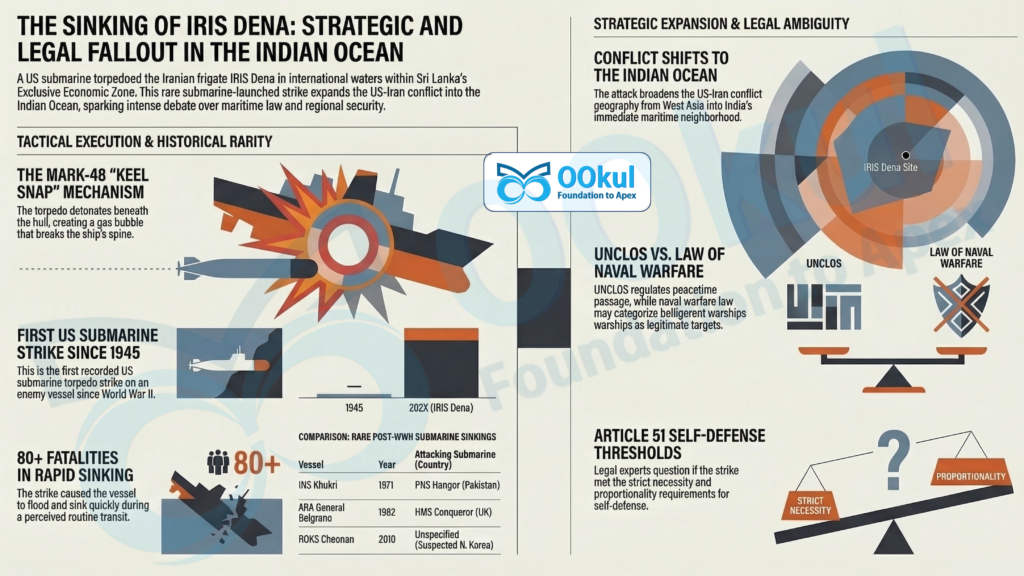
An American (US) submarine on Wednesday torpedoed the Iranian warship IRIS Dena off the coast of Sri Lanka, outside Sri Lanka’s territorial waters but within its Exclusive Economic Zone (EEZ). The frigate was returning to Iran after participating in:
International Fleet Review
MILAN-2026, a multilateral naval exercise organised by the Indian Navy off Visakhapatnam
The attack led to the sinking of the ship and the reported death of at least 80 sailors. Strategically, it has:
Expanded the theatre of the ongoing US–Israel–Iran conflict from West Asia and the Gulf region to the Indian Ocean, directly abutting India’s maritime neighbourhood.
Triggered a fresh debate in India on maritime security and the protection of warships transiting through international waters.
Location of the Attack
The spatial context of the attack is crucial:
Indian territorial sea: Extends 12 nautical miles from the baseline.
India’s Exclusive Economic Zone (EEZ): Extends up to 200 nautical miles.
Site of sinking: Within Sri Lanka’s EEZ off the coast of Galle, outside its 12 nautical mile territorial sea, i.e., in international waters for the purpose of navigation and passage rights.
International Maritime Law & Naval Warfare
UNCLOS and its Limits
Global maritime governance is primarily regulated by the United Nations Convention on the Law of the Sea (UNCLOS). Key points:
Scope: UNCLOS is focused on peacetime governance—maritime zones, navigation rights, resource exploitation, etc.
US status: The United States is not a signatory to UNCLOS, although it often follows many of its norms as customary international law.
Gap during conflict: UNCLOS does not explicitly regulate the conduct of belligerents during armed conflict at sea.
During war or armed conflict, the law of naval warfare operates in parallel with UNCLOS. Under this body of law:
A warship of a belligerent state is generally considered a legitimate military target, regardless of whether it is directly involved in combat at that moment.
UN Charter and Use of Force
The UN Charter provides the overarching framework on the use of force:
Article 2(4): Prohibits the threat or use of force against the territorial integrity or political independence of any state.
Article 51: Creates an exception by recognising the inherent right of individual or collective self-defence if an armed attack occurs.
Therefore, an attack on a foreign warship on the high seas must be justified under one of the following grounds:
Self-defence under Article 51 (e.g., response to an armed attack or an imminent armed attack).
Authorisation by the UN Security Council under Chapters VI/VII of the UN Charter, which requires:
A majority vote in the Security Council; and
No veto from any of the five permanent members (P5), including the US itself.
The ICRC Casebook also references Security Council authorisation as a valid basis for the use of force, recalling precedents like the 1990 Gulf War. However, such authorisations are politically difficult, especially when P5 members have conflicting interests or may exercise vetoes.
Sanctions on IRIS Dena
IRIS Dena was placed under US sanctions in February 2023 by the US Treasury Department, in connection with Iran’s alleged supply of unmanned aerial vehicles (UAVs) to Russia for combat operations in Ukraine. These UAVs were said to be used to target critical infrastructure.
Important clarifications:
Sanctions primarily restrict financial and commercial transactions, ship dealings, and technology transfers.
Sanctions do not automatically bar a sanctioned warship from participating in peacetime multilateral naval exercises hosted by other countries.
How the Mark-48 Torpedo Works
The likely weapon used in the attack is the Mark-48 heavyweight torpedo, the primary submarine-launched anti-ship weapon of the US Navy.
Key Features
Introduction: First fielded in 1972; periodically upgraded since.
Origin: Manufactured at a US Navy facility in Virginia.
Weight: Around 1,700 kg for recent variants.
Guidance: Uses sonar to detect and track its target.
Mechanism of Damage
The torpedo homes in on the ship and then dives beneath the hull.
It detonates with the force of roughly 500 pounds of TNT (or equivalent explosives).
The underwater explosion creates a large gas bubble that rapidly expands and collapses beneath the ship.
This dynamic shock and pressure cause intense metal fatigue, effectively snapping the ship’s keel (spine).
The hull can break into two or more pieces, causing rapid flooding and quick sinking.
Rarity of Submarine Torpedo Attacks on Major Warships
Since World War II, successful submarine-launched torpedo strikes that have sunk major warships have been uncommon. Notable cases include:
INS Khukri (9 December 1971) Indian frigate sunk by PNS Hangor (Pakistan Navy submarine) off Diu during the Indo-Pak war. 176 sailors lost their lives.
ARA General Belgrano (2 May 1982) Argentine cruiser sunk by UK submarine HMS Conqueror during the Falklands War. 323 sailors were killed.
ROKS Cheonan (26 March 2010) South Korean corvette that sank after a suspected North Korean torpedo attack.
The last recorded US submarine torpedo strike on an enemy vessel before this episode was by USS Torsk on 14 August 1945, which sank a 750-ton Japanese ship during World War II.
Why IRIS Dena Was Considered a ‘Prize Ship’
US Defense Secretary Pete Hegseth reportedly described IRIS Dena as a “prize ship”. In broad military and political terms, this suggests:
Symbolic value as a modern Iranian naval asset.
Potential role in strategic signalling to Iran regarding its regional posture and support to allies.
A message to other regional actors about the reach and resolve of US undersea forces.
Legal and Strategic Debate
No Fixed ‘War Zones’ at Sea
Vice Admiral G. Ashok Kumar (Retd), former Vice Chief of Naval Staff and India’s first National Maritime Security Coordinator, highlighted:
The maritime domain does not have fixed or formalised “war zones” in the same way as land theatres.
A warship of a belligerent navy remains a potential target wherever it sails, especially amid an ongoing conflict.
The incident is particularly “sad” for India given that the ship was returning from an Indian Navy–hosted international event, but legally the conflict began after Dena left Indian waters.
He further noted that the strike occurred in Sri Lanka’s EEZ, which facilitated a relatively quick search and rescue (SAR) effort by Sri Lanka. The proximity to the coast raises the possibility that the crew might have been aware of some threat or sought to remain in a monitored area.
Presumption of Illegality on the High Seas
Rear Admiral Sudhir Pillai NM (Retd), in a Substack essay, offered a more critical legal view:
The use of force against a foreign warship on the high seas is presumptively unlawful unless clearly justified as:
An act of self-defence under Article 51, or
Part of a recognised armed conflict with appropriate legal framing.
Any such strike needs to be assessed against the strict thresholds and tests of self-defence—necessity, proportionality, and immediacy of the threat.
Concerns from Indian Naval Officials
A senior Indian Navy official (unnamed) characterised the American submarine attack as a “big escalation” in the ongoing US–Israel–Iran confrontation:
The ship was on a peaceful passage, outside the main conflict geography.
Even if legally arguable, the attack broadens the geographic and operational scope of the war into the Indian Ocean.
Regarding the ship’s state of readiness, the official observed:
IRIS Dena likely carried basic defensive weapon systems, including:
Close-in weapon systems (CIWS) for last-ditch defence; and
Area defence systems for wider protective coverage.
Despite this, the ship was probably taken by surprise, struck in the early hours while on what was perceived as a routine and peaceful transit.
The crew may not have anticipated a torpedo attack in international waters so far from the primary conflict area.
Implications for India and the Indian Ocean
The incident has triggered serious reflection in India on the security architecture of the Indian Ocean Region (IOR):
India maintains a significant naval presence in the IOR, but:
Once a ship enters international waters, the scope for any state (including India) to provide direct protection is limited, especially against covert undersea threats.
The attack underscores the vulnerability of even modern warships to submarine-launched torpedoes.
It raises questions about the safety of warship participation in multilateral exercises when global conflicts are active.
Refine threat assessment and routing strategies for transiting warships.
Deepen information sharing and maritime domain awareness among IOR states.
Concise Summary
A US submarine torpedoed and sank the Iranian warship IRIS Dena in Sri Lanka’s EEZ, killing at least 80 sailors.
Dena was returning from MILAN-2026 and the International Fleet Review hosted by the Indian Navy off Visakhapatnam.
The strike has expanded the geographical scope of the US–Israel–Iran conflict into the Indian Ocean Region.
UNCLOS governs peacetime maritime conduct, while the law of naval warfare and the UN Charter (especially Article 51) regulate the use of force at sea.
IRIS Dena was under US sanctions since 2023 for alleged involvement in Iran’s UAV supplies to Russia, but sanctions did not bar its participation in Indian naval exercises.
The Mark-48 torpedo used in the attack is a heavyweight, sonar-guided weapon designed to break a ship’s keel by detonating beneath its hull.
Submarine torpedo attacks that sink major warships have been rare since World War II, with prominent examples including INS Khukri, ARA General Belgrano, and ROKS Cheonan.
Indian naval experts are divided: some stress the absence of fixed maritime war zones and the legal status of a belligerent warship as a legitimate target, while others call the strike presumptively unlawful without clear self-defence justification.
The attack raises serious questions for India’s maritime security, the safety of multilateral exercises, and the future of naval operations in the Indian Ocean.
Overview The Mission: The Solar wind Magnetosphere Ionosphere Link Explorer (SMILE) is a space mission designed to study how Earth’s magnetic field protects the planet
Introduction to the Proposed Bans Recently, Karnataka and Andhra Pradesh announced plans to restrict social media access for children under 16 and 13, respectively. This
Introduction West Asia is the world’s most important energy-producing region and a key supplier of crude oil and natural gas. Any geopolitical instability in the