Summary
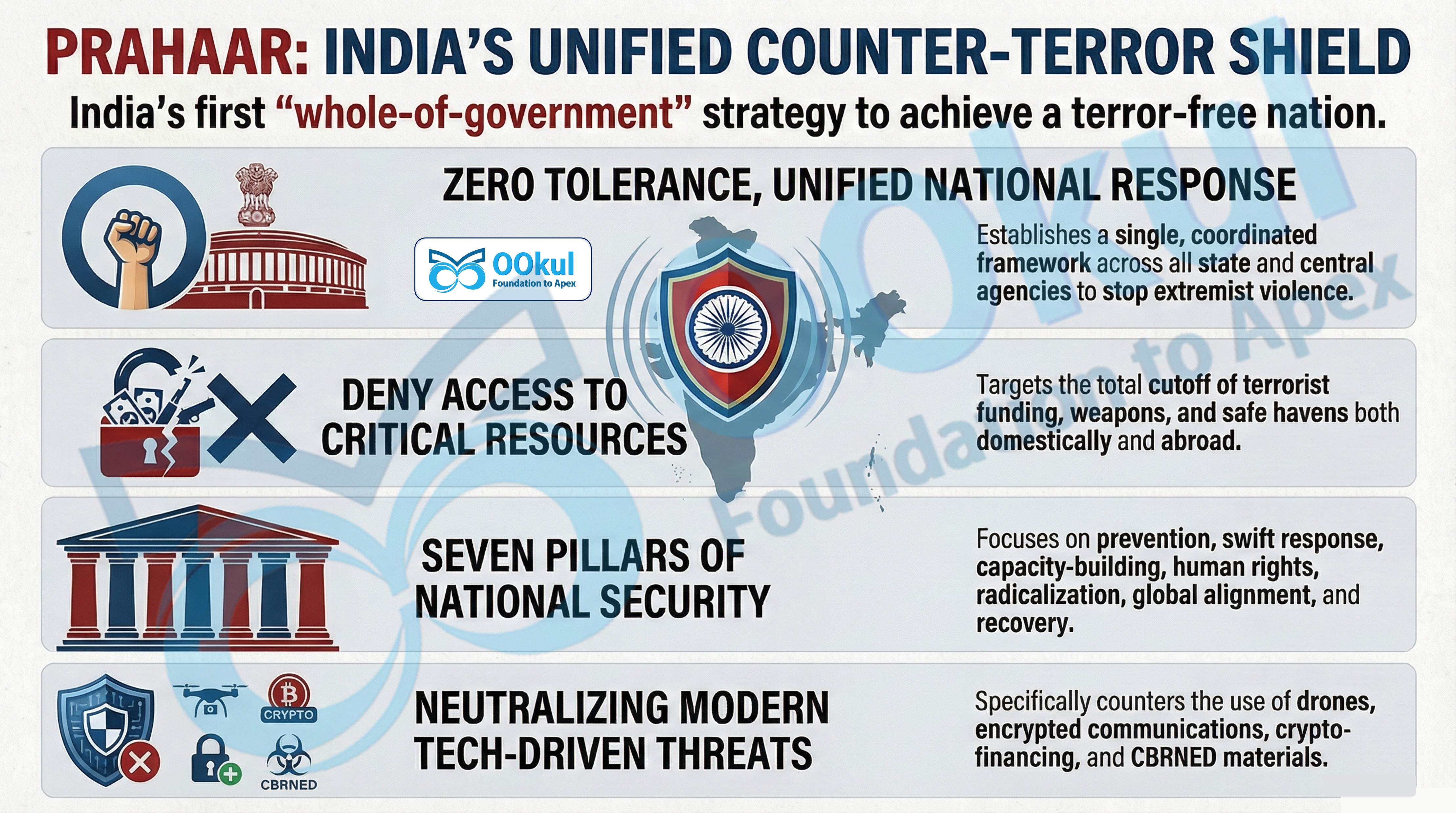
- Prahaar is India’s first formal, comprehensive counter-terrorism policy unveiled by the Ministry of Home Affairs (MHA).
- It is built on a zero-tolerance, intelligence-led, and coordinated response approach to terrorism.
- The core aim is to deny terrorists, their financiers and supporters access to funds, weapons and safe havens, both within India and abroad.
- The policy is structured around seven key pillars: prevention, response, capacity-building, human rights and rule of law, countering radicalisation, global alignment and leadership, and recovery & resilience.
- Prahaar recognises the evolving nature of terrorism, including the use of technology, drones, organised criminal networks, cyberattacks and CBRNED materials.
Introduction: What Is Prahaar?
- Prahaar is India’s first dedicated, overarching counter-terrorism policy framework.
- Announced by the Ministry of Home Affairs (MHA) on February 23 in New Delhi.
- Designed as a multi-layered, whole-of-government and whole-of-society strategy against terrorism.
- Guided by a zero-tolerance approach and a firm position that there is no justification for terrorism under any circumstances.
Core Objectives of Prahaar
- Deny access to critical resources for terrorists and their supporters:
- Funds and financial channels
- Weapons and explosives
- Safe havens and logistical support networks
- Strengthen intelligence-led prevention to stop attacks before they occur.
- Ensure swift, coordinated response to any extremist violence.
- Integrate domestic efforts with global counter-terrorism mechanisms.
- Build long-term resilience in society against radicalisation and extremist narratives.
India’s Stance on Terrorism
- Prahaar reiterates India’s long-standing position that:
- Terrorism cannot be linked to any religion, ethnicity or civilisation.
- There can be no justification for violence or terror in any form.
- The policy notes that some countries in the region have used terrorism as an instrument of state policy (without naming specific states).
- India has consistently stood by victims of terrorism globally and advocates a principled, zero-tolerance approach.
Threat Landscape Highlighted in Prahaar
Cross-Border and Global Terror Networks
- India has been a target of state-sponsored cross-border terrorism.
- Jihadi terror outfits and their front organisations are involved in:
- Planning and coordinating attacks
- Facilitating logistics
- Executing terror operations on Indian soil
- Global terror groups such as Al Qaeda and ISIS have tried to:
- Incite violence through sleeper cells
- Exploit local grievances and online propaganda
Use of Foreign Soil and Emerging Technologies
- Terror conspiracies are often planned from foreign soil.
- Handlers increasingly use advanced technologies to support attacks, especially in Punjab and Jammu & Kashmir:
- Drones for weapons, drugs, and explosives drops
- Secure communications and online coordination
Organised Crime, Social Media and Cyber Tools
- Organised criminal networks are being used for:
- Logistics and transport
- Recruitment
- Hawala and illicit financial flows
- Social media and messaging apps are key tools for:
- Propaganda and radicalisation
- Funding solicitations
- Real-time guidance for attacks
- Cyberattacks by criminal hackers and hostile nation-states are a growing concern.
Technological Challenges in Counter-Terrorism
- Technological evolution provides terrorists with a cloak of invisibility:
- Encryption of communications
- Dark web marketplaces and forums
- Crypto wallets and anonymous financial channels
- Disrupting terrorist access to CBRNED materials remains a major challenge:
- C – Chemical
- B – Biological
- R – Radiological
- N – Nuclear
- E – Explosive
- D – Digital
- Risk of misuse of drones and robotics for lethal purposes is highlighted.
The Seven Pillars of Prahaar
1. Prevention of Terror Attacks
- Emphasis on intelligence-led, proactive measures rather than reactive steps.
- Key aspects:
- Strengthening intelligence collection and analysis
- Improved information sharing between agencies
- Early identification of sleeper cells and support networks
- Monitoring of financial flows and suspicious transactions
2. Swift, Coordinated Responses to Extremist Violence
- Focus on rapid response mechanisms when an incident occurs.
- Key elements:
- Better coordination between central and state agencies
- Standardised operational protocols for different types of attacks
- Enhanced crisis management and command-control systems
- Quick deployment of specialised counter-terror units
3. Enhancing Internal Capacities
- Building robust institutional and operational capacity within India.
- Likely focus areas include:
- Training and modernisation of police and security forces
- Upgrading surveillance, forensic and cyber capabilities
- Better border management and monitoring of infiltration routes
- Strengthening legal and investigative frameworks
4. Upholding Human Rights and Rule-of-Law-Based Processes
- Prahaar underlines that counter-terror efforts must remain within the framework of the Constitution.
- Key themes:
- Respect for human rights during operations and investigations
- Ensuring due process and fair trials
- Preventing misuse of counter-terror laws against legitimate dissent
- Maintaining public trust in state institutions
5. Countering Conditions That Enable Terrorism, Including Radicalisation
- Recognises that terrorism thrives in certain enabling environments.
- Likely areas of intervention:
- Addressing radicalisation pathways, especially online
- Community outreach and engagement with vulnerable groups
- Promoting counter-narratives to extremist ideologies
- Working with educational and religious institutions to build resilience
6. Aligning With and Shaping Global Counter-Terrorism Efforts
- India aims not only to align with, but also shape international norms and cooperation on counter-terrorism.
- Key dimensions:
- Stronger role in UN and multilateral platforms
- Enhanced intelligence and information sharing with partner countries
- Push for global accountability of states that sponsor or shelter terrorists
- Cooperation on terror financing, cyber and tech-based threats
7. Recovery and Resilience Through a Whole-of-Society Approach
- Focuses on how society recovers and bounces back after terror incidents.
- Key aspects:
- Support systems for victims and affected communities
- Psychosocial care and rehabilitation
- Strengthening community cohesion to avoid polarisation
- Involving civil society, media, and local institutions in resilience-building
Significance of Prahaar
- Provides a single, coherent national framework for counter-terrorism.
- Integrates security, legal, technological and societal dimensions.
- Updates India’s approach to reflect new-age threats such as:
- Encrypted communications
- Dark web and crypto financing
- Drones, robotics and CBRNED risks
- Cyber-enabled attacks and influence operations
- Reinforces India’s position as a principled, rights-respecting democracy combating terrorism.
Conclusion
- Prahaar marks a major milestone in India’s internal security architecture.
- By combining zero tolerance with rule-of-law and human rights safeguards, it seeks to create a balanced yet firm response to terrorism.
- The policy’s success will depend on:
- Effective implementation across central and state agencies
- Continuous upgradation of technology and capacities
- Sustained community participation and international cooperation
- As terrorism becomes more networked, tech-driven and transnational, Prahaar is intended to be India’s comprehensive blueprint to stay ahead of evolving threats.
Source: Indian Express