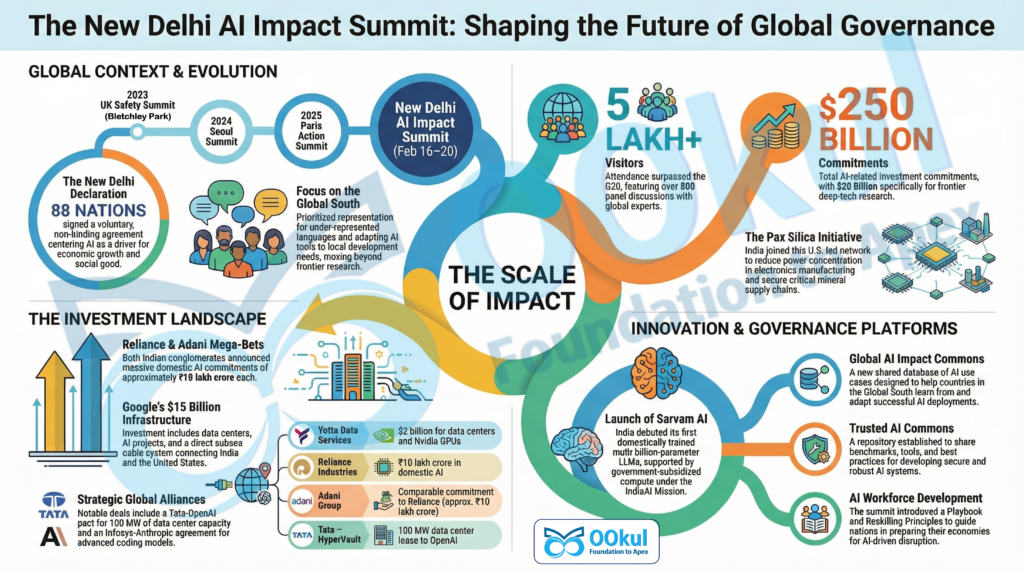
AI Impact Summit & New Delhi Declaration: Key Takeaways in Brief

1. Quick Summary of the AI Impact Summit

  • Event: AI Impact Summit, New Delhi, February 16–20
  • Scale: Over 5 lakh visitors, 500+ discussions, top global AI CEOs and heads of state
  • Key Outcome: New Delhi Declaration on AI signed by 88 countries and international organisations
  • Focus: Democratising AI, making it safe and trusted, and relevant to the Global South
  • Investments: About $250 billion in overall AI commitments and $20 billion for frontier deep-tech research

2. Background: How Did AI Summits Evolve?

  • Start of formal AI summits: Since 2023, with annual global gatherings.
  • Key milestones:
    • 2023 – Bletchley Park, UK: Focus on AI safety; India represented by MoS IT Rajeev Chandrasekhar.
    • 2024 – Seoul: Continued multilateral dialogue on AI governance.
    • 2025 – Paris AI Action Summit: Co‑chaired by PM Narendra Modi and French President Emmanuel Macron. Marked a shift as U.S. Vice‑President J.D. Vance rejected a strict “safety‑first” line, pushing for innovation and investment.
  • No permanent global body yet: Each host country passes on the baton to the next; no standing international organisation manages these summits.

3. India-Hosted Summit: Main Goals

3.1 Global Priorities

  • Democratisation of AI: Ensure AI capabilities reach as many people as possible.
  • Global South focus:
    • Better representation of under‑represented languages in AI models.
    • Adapt AI solutions to local contexts and development needs.
  • Safe and trusted AI: Promote norms, tools, and practices that make AI secure, reliable, and accountable.

3.2 Domestic Priorities

  • Make India an AI hub:
    • Attract investment in AI infrastructure and research.
    • Showcase India as a competitive destination for data centres and AI labs.
  • Boost AI-led development:
    • Encourage AI use in healthcare, agriculture, education, and public services.
    • Support startups and domestic AI companies.
  • Thematic working groups:
    • Human capital
    • Inclusion for social empowerment
    • Safe and trusted AI
    • Resilience, innovation, and efficiency
    • Science and democratising AI resources
    • AI for economic development and social good

4. Key Outcomes of the Summit

4.1 Scale and Participation

  • Over 5 lakh visitors, surpassing the G20 Summit attendance.
  • More than 500 panel discussions and sessions with international experts.

4.2 Investment and Strategic Initiatives

  • Total commitments:
    • ~$250 billion in AI-related investments.
    • ~$20 billion earmarked for frontier deep‑tech AI research.
  • Pax Silica initiative:
    • India joined the U.S.-led Pax Silica network.
    • Aim: reduce concentration of power in electronics manufacturing and critical minerals; build a coalition of like‑minded countries.
  • New Delhi Declaration on AI:
    • Signed by 88 countries and international organisations, including the U.S., China, France and other AI powers.
    • Centres AI as a driver of economic growth and social good.

4.3 Domestic AI Breakthrough: Sarvam AI

  • Launch of India’s first domestically trained multi‑billion‑parameter LLMs by Sarvam AI (Bengaluru‑based).
  • Support:
    • Private equity funding.
    • Government backing via subsidised compute under the IndiaAI Mission.
  • Model features:
    • Claimed to be efficient and competitive on benchmarks.
    • Open‑source release, with a beta chatbot interface launched after the summit.

4.4 Operational and Image Setbacks

  • Overcrowding & logistics:
    • Unexpectedly high turnout on opening day.
    • Security bottlenecks and traffic snarls delayed even some speakers.
  • Robodog controversy:
    • Galgotias University exhibited a Chinese‑made robodog as a student project.
    • After public exposure, organisers asked the university to vacate the expo.
  • Political protest:
    • Indian Youth Congress members staged a protest at the expo with hidden T‑shirts reading “Modi is Compromised”.
    • They were detained; Delhi Police initiated an investigation.

5. Investment Commitments: Who Is Betting on India’s AI?

5.1 Large Indian Conglomerates

  • Reliance Industries Ltd. (RIL)
    • Announced commitments of around ₹10 lakh crore in domestic AI.
  • Adani Group
    • Announced a similar scale of commitment in domestic AI (comparable to RIL’s figure).

5.2 Other Major Investors Beyond Reliance & Adani

  • Google
    • Shared more details on its existing $15 billion investment in India.
    • Includes data centre and AI projects and a subsea cable system directly connecting India and the U.S.
  • Tata Group – OpenAI Pact
    • OpenAI to lease 100 MW of data centre capacity from Tata’s HyperVault.
    • OpenAI will provide its advanced models to Tata employees.
  • Infosys – Anthropic Agreement
    • Partnership for access to Anthropic’s advanced AI models.
    • Notable in the context of investor reactions to Anthropic’s strong coding LLM performance.
  • Yotta Data Services
    • Announced $2 billion investment in data centre infrastructure in India.
    • Will deploy Nvidia GPUs to power AI workloads.

6. The New Delhi Declaration on AI

6.1 Who Signed It?

  • Signatories: 88 countries and international organisations.
  • Includes major AI powers such as the United States, China, and France.

6.2 Nature of Commitments

  • Commitments are explicitly described as “voluntary” and “non‑binding”.
  • Design choice aimed at maximising participation and building broad consensus.

6.3 Core Themes

  • Democratic diffusion of AI:
    • Charter to ensure AI benefits are widely shared across countries and populations.
    • Particular emphasis on inclusion of the Global South.
  • Safe, secure, and trustworthy AI:
    • Encourages best practices, benchmarks, and tools to mitigate AI risks.
  • AI for economic growth and social good:
    • Reinforces AI’s role in development, public services, and social empowerment.

7. Global AI Impact Commons & Other New Platforms

7.1 What Is the Global AI Impact Commons?

  • Definition: A shared database of AI use cases from around the world.
  • Aim:
    • Help countries, especially in the Global South, learn from existing AI deployments.
    • Allow policymakers and practitioners to draw inspiration and adapt successful models.
    • Reduce duplication of effort and lower the entry barrier to impactful AI projects.

7.2 Trusted AI Commons

  • Purpose: A repository of tools, benchmarks, and best practices.
  • Goal: Support the development of secure, robust, and trustworthy AI systems globally.

7.3 Other Declared Initiatives

  • International Network of AI for Science Institutions
    • Links technical and scientific institutions worldwide.
    • Aims to accelerate AI‑driven scientific research through collaboration.
  • AI for Social Empowerment Platform
    • Focus on AI applications that improve inclusion, welfare, and public services.
  • AI Workforce Development Playbook and Reskilling Principles
    • Guidance for countries on skills, training, and reskilling in an AI‑driven economy.
  • Guiding Principles on Resilient and Efficient AI
    • Encourages building AI systems that are energy‑efficient, robust, and resilient to disruptions.

8. Why This Summit Matters

  • For India:
    • Positions India as a major AI policy convener and investment destination.
    • Showcases domestic capability through initiatives like Sarvam AI.
  • For the Global South:
    • Pushes language inclusion, access to tools, and shared knowledge platforms.
    • Provides a template for development‑oriented AI rather than only frontier research.
  • For global AI governance:
    • Reinforces a multi‑polar, cooperative approach to AI.
    • Balances innovation and investment with the need for safety and trust.

Source: The Hindu

Share:

More Posts

Send Us A Message

Login to Get Excited Offer !