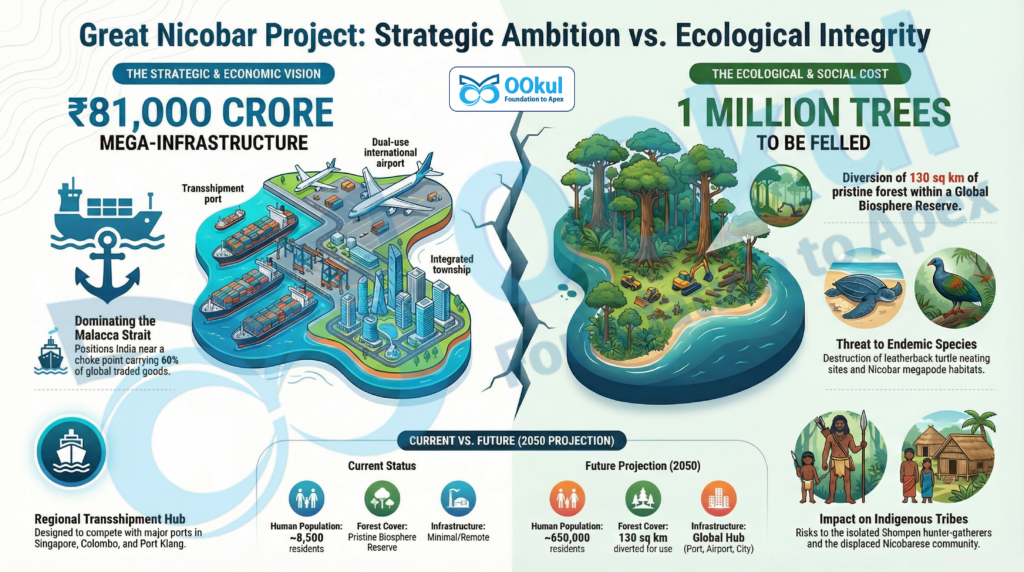
Great Nicobar Mega Project: Strategic Promise vs Ecological Risk

Summary

  • The National Green Tribunal (NGT) has upheld environmental clearance for the Rs 81,000-crore Great Nicobar mega infrastructure project, citing its strategic importance and existing safeguards.
  • The project aims to develop Great Nicobar Island into a major economic and defence hub with a transshipment port, dual-use airport, integrated township, and power plant.
  • It will divert around 130 sq km of pristine forest, fell nearly a million trees, and impact critical habitats, including turtle nesting sites and endemic species such as the Nicobar megapode.
  • The project area lies within the Great Nicobar Biosphere Reserve, part of the Sundaland biodiversity hotspot, and will affect indigenous Shompen and Nicobarese communities.
  • The population of the island is projected to rise from about 8,500 (2011) to around 6.5 lakh by 2050, raising serious concerns about ecological sustainability and cultural impacts.

1. Background: NGT Clearance and Its Significance

  • Tribunal decision
    • NGT has cleared the way for the Great Nicobar project, upholding its environmental clearance.
    • The order highlights the project’s “strategic importance” and notes that there are “adequate safeguards” built into the clearance conditions.
  • Precedent for future projects
    • The decision is likely to become a reference point for future strategic projects proposed in ecologically sensitive areas.
    • It raises broader questions on how India will balance security and economic goals with environmental protection and indigenous rights.

2. The Great Nicobar Island: Location and Importance

  • Geographic profile
    • Great Nicobar Island area: 910 sq km.
    • Home to Indira Point, India’s southernmost location.
    • Remote, sparsely populated, and ecologically rich.
  • Protected status
    • Almost the entire island (excluding revenue land) is part of the Great Nicobar Biosphere Reserve.
    • Part of the wider Sundaland biodiversity hotspot, known for high endemism and vulnerability.

3. Core Components of the Mega Project

  • Overall vision
    • Transform Great Nicobar into an economic and defence hub.
    • Estimated cost: Rs 81,000 crore.
    • Initially conceptualised by NITI Aayog; implementation now with the Andaman and Nicobar Island Integrated Development Corporation Ltd (ANIIDCO).
  • Four main pillars
    • Integrated township
      • Area: ~149 sq km.
      • Includes residential, commercial, tourist, logistics, and defence facilities.
      • Planned as a comprehensive urban and defence ecosystem.
    • Transshipment port at Galathea Bay
      • Area: ~7.66 sq km.
      • Located at the southern tip of the island at Galathea Bay.
      • Designed to handle around 14.2 million TEU (twenty-foot equivalent units) annually.
      • Will compete with major regional hubs like Colombo, Hambantota, Port Klang, and Singapore.
    • Dual-use international airport
      • Area: ~8.45 sq km.
      • Dual-use: civilian and military operations.
      • Second airport on the island after the Navy’s airstrip at INS Baaz, Campbell Bay.
      • Requires acquisition of about 4.2 sq km of land, affecting 379 families (primarily mainland settlers).
    • Gas and solar-based power plant
      • Capacity: 450 MVA (megavolt ampere).
      • Area: ~0.39 sq km.
      • Intended to support the energy needs of the township, port, and airport.
  • Land reclamation and material needs
    • Land reclamation
      • Port: ~2.98 sq km of reclaimed land.
      • Airport: ~1.94 sq km of reclaimed land.
    • Construction materials
      • Estimated 33.35 million cubic metres of material needed.
      • Includes cement, rocks, sand, and steel to be shipped to the island, increasing marine traffic and associated impacts.

4. Strategic Drivers Behind the Project

  • Geopolitical and maritime significance
    • Great Nicobar is India’s closest territory to the Malacca Strait.
    • The Malacca Strait is a major maritime choke point connecting the Indian Ocean and the Pacific Ocean.
    • According to the World Economic Forum:
      • ~94,000 ships pass through annually.
      • Handles about 60% of global traded goods.
      • Carries roughly one-third of the world’s maritime oil trade.
  • Transshipment hub ambitions
    • Transshipment ports transfer containers from large mother vessels to smaller feeder ships.
    • India currently has only one operational transshipment port at Vizhinjam (Kerala).
    • Great Nicobar’s port aims to capture a share of regional transshipment traffic dominated by Colombo, Hambantota, Port Klang, and Singapore.
  • Defence and security dimension
    • India has been upgrading defence infrastructure in the Andaman and Nicobar Islands:
      • Revamping airfields, jetties, storage, and surveillance facilities.
      • Andaman and Nicobar Command (tri-services) operational at Port Blair since 2001.
      • INS Baaz Naval Air Station at Campbell Bay already provides a strategic vantage point.
    • The Great Nicobar project embeds defence infrastructure within its first construction phase, reinforcing India’s strategic posture in the Indo-Pacific.

5. Ecological Impacts: Forests, Wildlife, and Habitats

  • Forest diversion and tree felling
    • Approximately 130 sq km of pristine forest will be diverted.
    • Nearly one million trees are expected to be felled.
    • Forests include:
      • Littoral (coastal wetland) forests.
      • Mixed evergreen forests.
      • Evergreen hill forests.
  • Biodiversity hotspot concerns
    • Nicobar group of islands forms part of the Sundaland biodiversity hotspot.
    • High levels of endemism (species found nowhere else) and vulnerability to disturbance.
  • Denotification of protected areas
    • Galathea Bay Wildlife Sanctuary and a Megapode Wildlife Sanctuary have been denotified to make way for project components.
    • This removes a layer of legal protection from critical habitats.
  • Impact on flagship and endemic species
    • Leatherback turtles
      • Galathea Bay is an important nesting site for leatherback turtles.
      • The environmental clearance itself acknowledges potential adverse impacts on these nesting sites.
      • A condition has been imposed that no activities be undertaken on the island’s western parts, viewed as possible alternative nesting areas.
    • Nicobar megapode
      • A ground-dwelling bird found only on the Nicobar Islands.
      • Builds characteristic nesting mounds, which are sensitive to disturbance.
      • The project area will directly affect these nesting mounds.
  • Compensatory conservation measures
    • To offset denotification and habitat loss, the Andaman and Nicobar Administration has been asked to notify:
      • A leatherback turtle sanctuary on Little Nicobar Island.
      • A Megapode sanctuary on Menchal Island.
      • A coral sanctuary covering the entire Meroe Island.
    • Key questions remain on whether such off-site sanctuaries can adequately compensate for the loss of core habitats at Galathea Bay and Great Nicobar.

6. Social and Cultural Impacts: Indigenous Communities

  • Shompen community
    • Indigenous, hunter-gatherer community.
    • Estimated population: around 250.
    • Live in relative isolation, with minimal contact with the outside world.
    • Depend on forests and tribal reserves that will be affected by the project.
    • Researchers have raised concerns about:
      • Health risks due to increased exposure to outsiders.
      • Disruption of traditional livelihoods and cultural practices.
  • Nicobarese community
    • Experienced heavy losses during the 2004 tsunami.
    • Currently reside in Rajiv Nagar and New Chingenh settlements in Campbell Bay.
    • Have a long-standing demand to be resettled in their pre-tsunami villages.
    • The tribal council has alleged that the administration is pressuring them to surrender claims to these original villages.
  • Tribal council’s position
    • The tribal council of Great Nicobar has, in the past:
      • Revoked its no-objection certificate (NOC) for the denotification of a tribal reserve.
      • Cited concealment of information regarding the project’s scope and impacts.
    • These developments highlight tensions around consent, transparency, and rights of indigenous peoples.

7. Demographic and Developmental Pressures

  • Projected population surge
    • Current population (2011 Census): ~8,500.
    • Projected population by 2050: ~6.5 lakh.
    • This implies a massive demographic transformation in a fragile island ecosystem.
  • Key concerns
    • Ecological carrying capacity: Can the island’s ecosystems sustain such a sharp rise in population and infrastructure?
    • Resource pressures: Increased demand for water, energy, waste management, and transport.
    • Cultural displacement: Risk of marginalisation of indigenous communities amid large-scale in-migration and urbanisation.

8. Balancing Strategy and Sustainability: Key Takeaways

  • Strategic gains
    • Enhanced maritime presence near the Malacca Strait.
    • Potential to emerge as a major transshipment hub in the Indian Ocean.
    • Strengthened defence infrastructure in a geopolitically sensitive region.
  • Ecological and social costs
    • Loss of pristine forests and critical wildlife habitats.
    • Threats to endemic species like the Nicobar megapode and to leatherback turtle nesting.
    • Serious implications for indigenous communities (Shompen and Nicobarese) and their rights.
    • Long-term sustainability questions due to rapid population growth and urbanisation pressures.
  • Policy and governance questions
    • How should India prioritise between strategic infrastructure and ecological integrity in sensitive regions?
    • Are compensatory sanctuaries and mitigation measures enough to offset the loss of unique habitats?
    • To what extent are free, prior, and informed consent and tribal rights being respected in project planning and implementation?

9. Conclusion

  • The Great Nicobar mega project encapsulates a core dilemma in India’s development trajectory: leveraging strategic geography while safeguarding ecologically fragile islands and indigenous cultures.
  • With the NGT’s clearance, implementation is likely to accelerate, making it even more crucial to:
    • Continuously monitor environmental impacts.
    • Strengthen safeguards for wildlife and forests.
    • Ensure meaningful participation and rights protection for the Shompen and Nicobarese communities.
  • How India manages Great Nicobar could set a precedent for future island and coastal megaprojects—either as a model of balanced development or as a cautionary tale of irreversible ecological loss.

Source: Indian Express

Share:

More Posts

Send Us A Message

Login to Get Excited Offer !